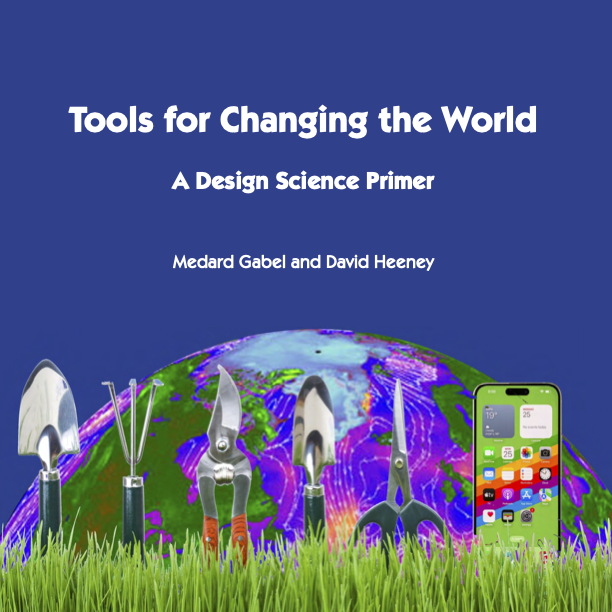

Tools for Changing the World

A Design Science Primer

A comprehensive guide to systems thinking, strategic planning, and creating meaningful change at any scale–from community projects to global initiatives.

A Practical Guide to Systems Change

Drawing on decades of experience with the World Game and Global Solutions Lab, this book offers a proven methodology for addressing complex challenges through whole-system thinking and collaborative design.

  • How to think in systems—seeing problems as interconnected wholes rather than isolated parts
  • Practical tools for mapping complex situations, identifying leverage points, and designing comprehensive strategies
  • A repeatable process for moving from vision to implementation at any scale
  • How to work effectively across disciplines, sectors, and cultures
  • Real-world examples from teams addressing global challenges
  • Access to 50+ global data sources and solution libraries

What's Inside the Book

Part 1 — Starting Up: Frames of Reference

Explores human and natural flourishing, global goals, models of change, and why a whole-system, long-term perspective is essential for serious problem-solving.

Part 2 — Tools: Concepts & Lenses

Introduces key conceptual tools: systems thinking, "Spaceship Earth," making visible the invisible, mapping, modeling, scenarios, indicators, and trim tabs/tipping points.

Part 3 — The Design Science Planning Process

Lays out a practical, iterative process for recognizing problem situations, defining preferred, problem, and present states, identifying alternatives, and designing strategies.

Part 4 — Implementation: Taking the Initiative

Focuses on developing artifacts and policies, proof-of-concept projects, timelines, partners, funding strategies, and communications plans to achieve impact at scale.

Appendices

  • 50+ global data sources
  • Solution libraries
  • Global Solutions Lab methodology
  • Comprehensive bibliography

Explore Further

The following resources supplement the book and ar available as free downloads. Additional materials will be added over time.

Table of Contents

A full chapter-by-chapter outline of Tools for Change the World.

Download PDF

Applying Design Science Locally

A supplement exploring how Design Science principles apply at the community and local level

Download PDF

The Design Science Process

A repeatable framework for turning vision into reality

The Design Science Process
This process is technology-agnostic, sector-independent, and globally applicable –– from community projects to national policy and global systems.

Who Should Read the Book

Social Entrepreneurs

Building ventures that create lasting change

Community Leaders

Addressing local changes with systemic thinking

Policy Makers

Designing policies that work across sectors

Students and Educators

Learning and teaching systems change

NGO Professionals

Developing programs with lasting impact

Change Agents

Anyone committed to making a real difference


Proven Methodology, Global Impact

35+

COUNTRIES REPRESENTED

>20

YEARS OF GLOBAL SOLUTIONS LAB

5

CONTINENTS

The methodology described in the book has been used by international teams working on:

  • Renewable energy systems and global/local transitions to clean abundant energy 
  • Food security & regenerative agriculture
  • Clean water and sanitation
  • Healthcare access
  • Climate mitigation & adaptation
  • Educational equity
  • Electrifying Africa
  •  . . . and dozens of other critical issues.

Testimonials

"Most books about changing the world tell you what needs to change. This one hands you the tools to actually do something about it. The Design Science framework cuts through the noise — no ideology, no hand-wringing, just a rigorous process for moving from 'the world is broken' to 'here's the plan.' The Global Solutions Lab (GSL) was where I first encountered this way of thinking, and it genuinely rewired how I approach problems. Whether you're working on a local initiative or something that scales globally, this primer gives you a methodology worth returning to."

Global Solutions Lab Participant
"The most comprehensive and practical guide to systems-level change I've encountered"
University Professor
Sustainability Studies


About the Authors

Medard Gabel

Medard Gabel

Medard Gabel is the founder of BigPictureSmallWorld and Executive Director of EarthGame, a nonprofit research and development organization. He is also the founding director of the World Game Institute and director of the Global Solutions Lab, now in its 22nd year.

He worked directly with Buckminster Fuller for over a decade on the development of the World Game, regenerative resource strategies, and whole-systems approaches to global problem solving. The AI-assisted strategic planning platform NewWorld Game represents the ongoing culmination of this work.

Medard is the author of seven books, including Energy, Earth and Everyone and Ho-Ping: Food for Everyone, as well as numerous articles and short films. His work focuses on global energy and food systems, multinational corporations, regeneration, strategic planning, and large-scale problem solving.

Working with Fuller, he developed a deep commitment to whole-systems thinking, global perspectives, and the integration of analytical rigor with creativity and humor.

David Heeney

David Heeney

David Heeney is a management consultant and founder of IndEco Strategic Consulting, a firm named for INDustrial ECOlogy, the science of sustainability. IndEco works on energy efficiency, climate change mitigation, and strategic planning with clients in Canada and internationally. Trained in environmental design, David has long been inspired by Buckminster Fuller and his participation in the World Game Laboratory.

Over many years David has also been a facilitator or member of teams developing strategies to address global problems at the Global Solutions Lab, including strategies for the global health system, global and urban food systems, and environmental protection.

David sees the present moment as a pivotal one for humanity and is committed to helping people recognize their own capacity to address systemic problems with creativity, cooperation, and foresight.

Get the Book

Tools for Changing the World is available as a carefully designed paperback on Amazon and as a free digital download. Many readers use the print edition as their working reference and the PDF for quick search and sharing.

The methodology is designed to be used, marked up, and returned to as you work on real projects—alone or with teams.